
For small orders of 20, 50 or 100 products, custom packaging can account for a substantial share of the total cost. A quotation for a small number of boxes may even be close to the price for several hundred. Why does ordering fewer boxes not always mean a much lower packaging bill?
Understanding how the packaging supplier quotes, then comparing quantities and packaging options, makes it easier to choose what suits a first order.
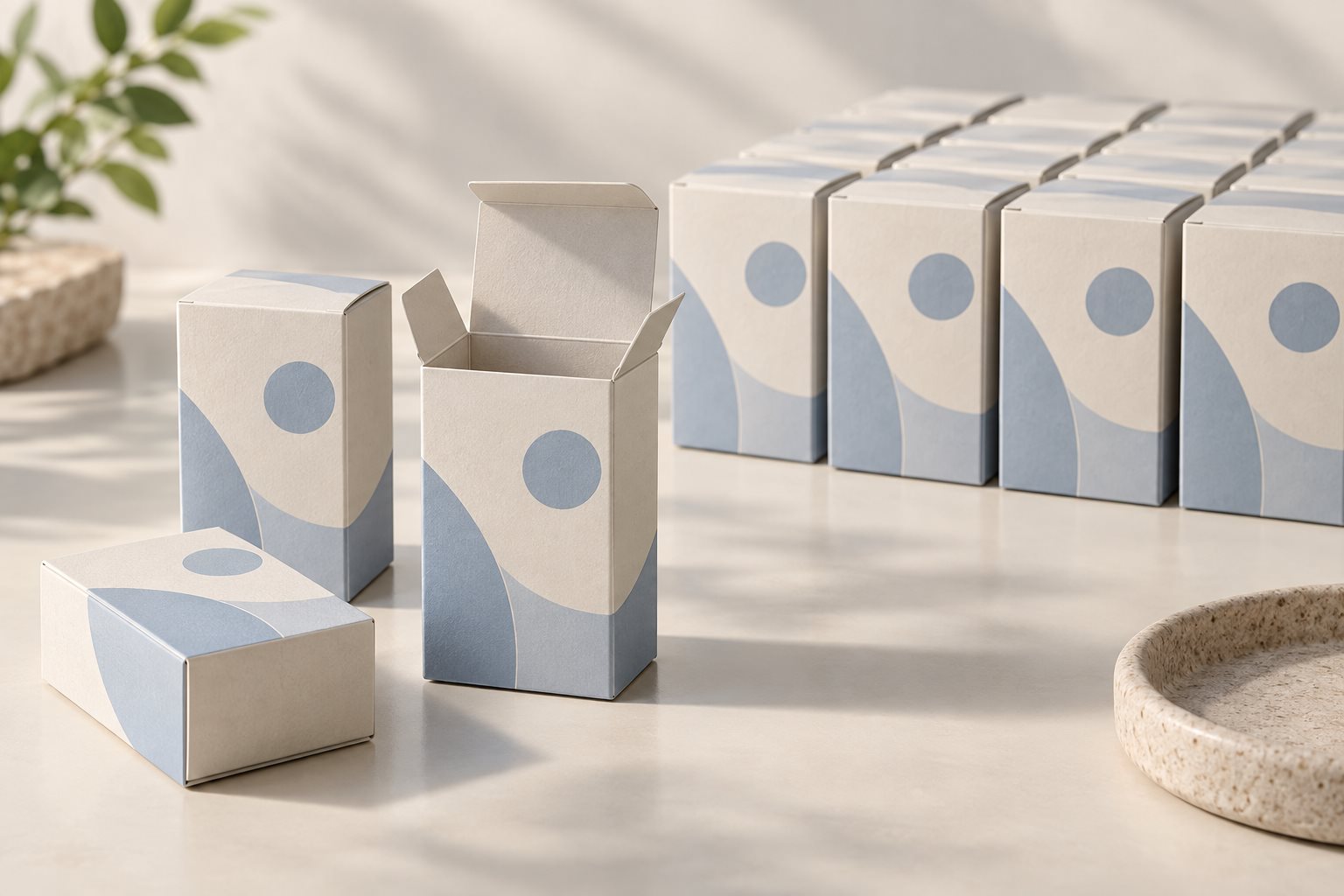
Why can 20 boxes and 200 boxes have the same total price?
The product manufacturer and the packaging supplier are often separate businesses. The manufacturer can help arrange custom packaging, but the boxes are priced according to the packaging supplier’s quotation.
A packaging supplier may quote the same total price for a range of small quantities. An order of 20, 50, 100 or 200 boxes may therefore cost the same. Depending on the quotation, that range may extend to 500 boxes or more.
Needing fewer boxes does not necessarily reduce the total packaging bill in the same proportion. When the same bill is divided among fewer products, the packaging cost per product is higher.
A simple price example
Imagine the supplier quotes the following prices for the same box, with the same dimensions, material and printed design.
These are illustrative amounts, not a quotation. Actual prices and quantity ranges depend on the packaging specifications and the supplier’s final quotation. All amounts below are in US dollars.
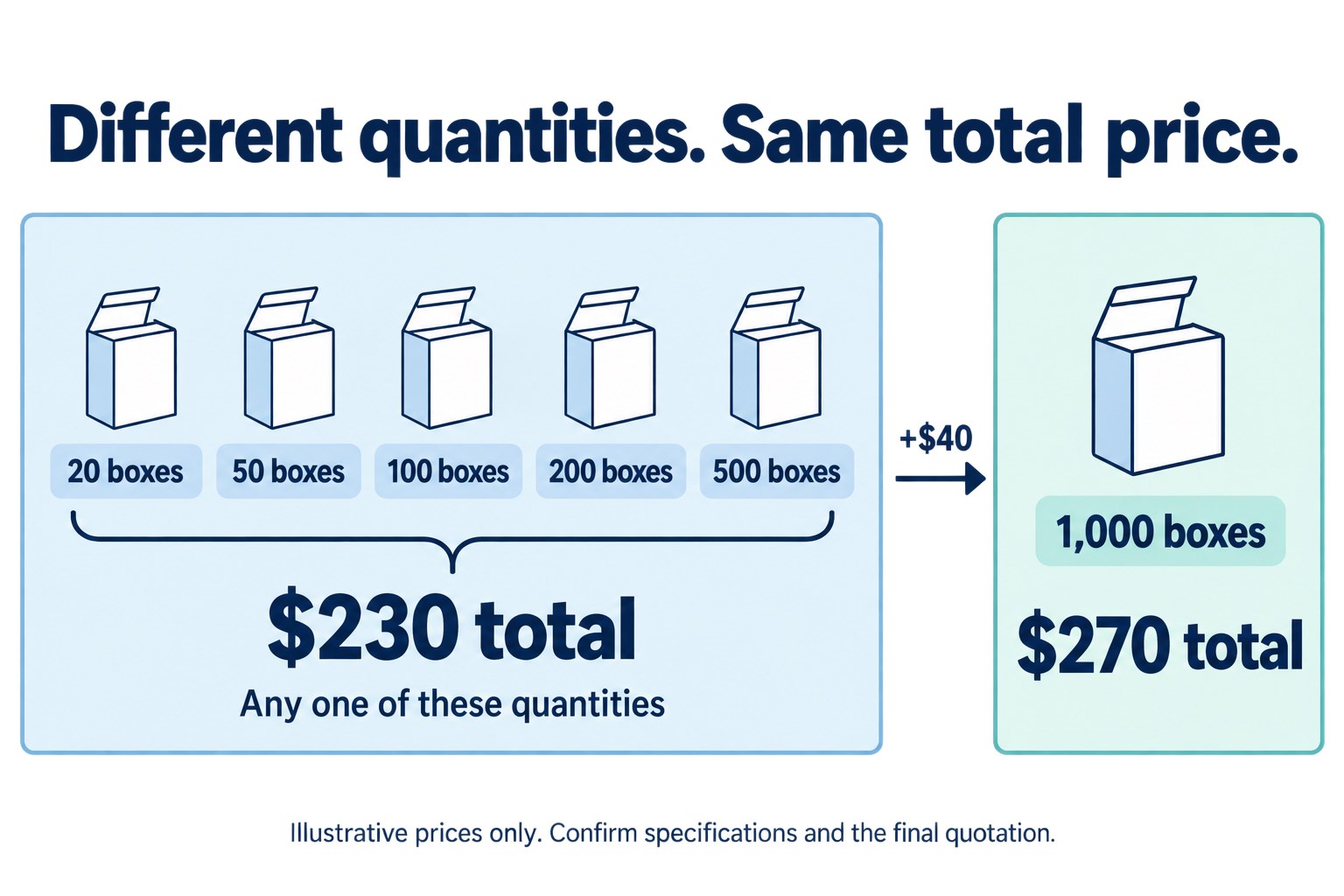
| Number of boxes | Total packaging cost | Average cost per box |
|---|---|---|
| 20 | $230 | $11.50 |
| 50 | $230 | $4.60 |
| 100 | $230 | $2.30 |
| 200 | $230 | $1.15 |
| 500 | $230 | $0.46 |
| 1,000 | $270 | $0.27 |
Here is the simplest way to read the example:
- Only need 20 boxes? The total is still $230. Although 500 boxes average $0.46 each, multiplying $0.46 by 20 does not give the price of a 20-box order. That would be $9.20, but this example quotation charges the same $230 total for 20 through 500 boxes.
- Need 50, 100 or 200? The total is also $230. What changes is the average cost per box, rather than the amount paid for the order.
- Moving from 500 to 1,000 boxes adds $40. The quantity doubles, but the total rises from $230 to $270.
When asking about custom packaging, one useful question is:
How many boxes can be produced for this total price?
This helps explain what the quotation covers, rather than looking only at the price per box.
What happens to packaging left over from the first order?
Suppose the first product order is for 50 pieces, while the packaging quotation allows for 500 boxes. After the first 50 products are packed, 450 boxes remain.
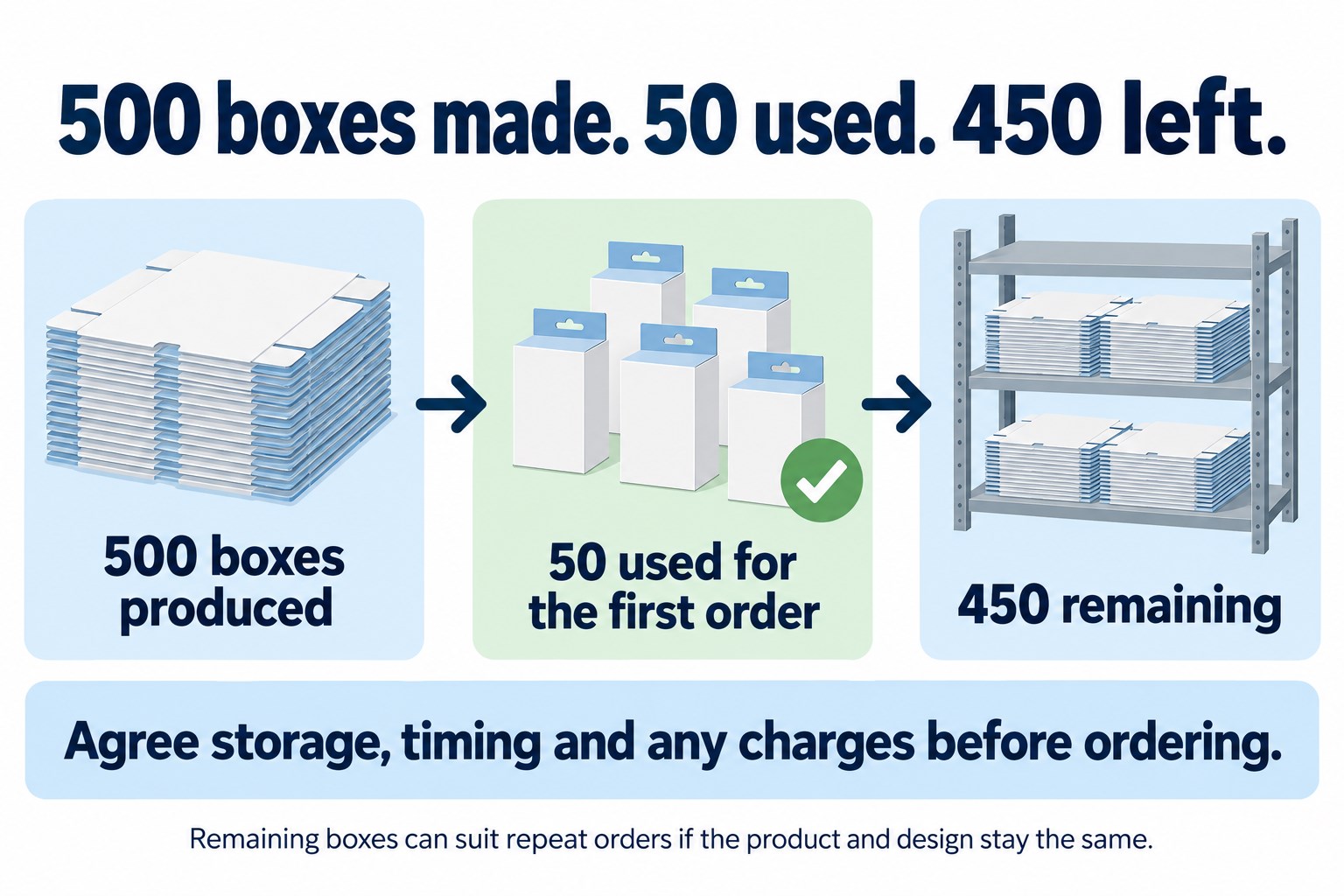
If more of the same product will be ordered with the same branding, the remaining boxes may be useful for a later batch. The brand and product factory should agree in advance:
- Whether the factory can store the remaining packaging.
- How long it can be stored and whether storage charges apply.
- How the remaining boxes will be used for repeat orders.
- What happens if the product dimensions or packaging design change.
Keeping extra packaging makes sense when it is likely to be used. If the product, brand design or printed wording is still being decided, possible changes should be considered before producing a larger quantity.
For a small trial order, another packaging option may be more suitable.
Record the packaging arrangement in the purchase brief, including the unit dimensions, artwork version, quantity, and who will supply the boxes. The packaging quotation should identify the exact box specification and total cost.
Four packaging options to consider
Brands can choose an approach that fits their budget, sales plans and expected repeat orders.
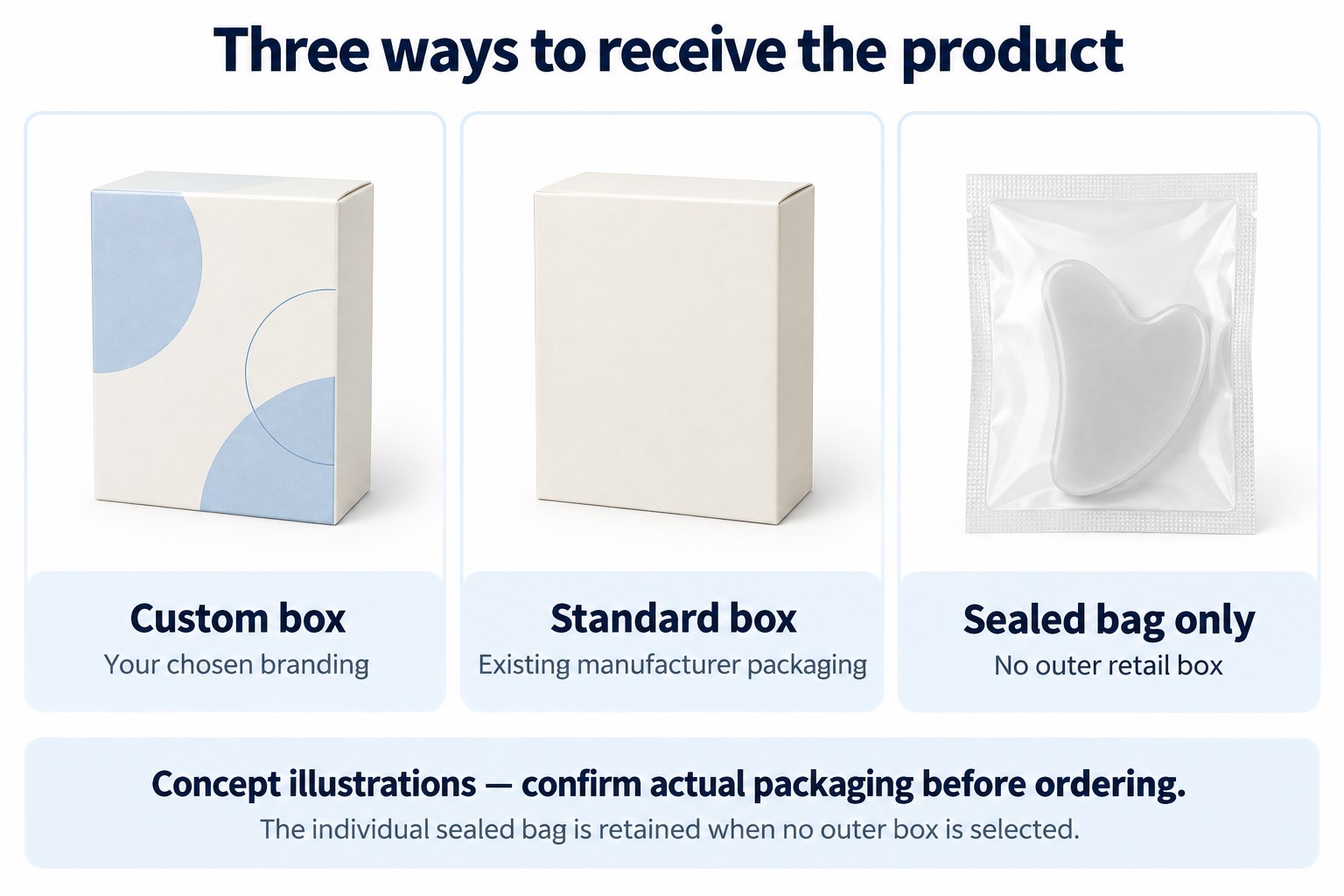
1. Custom packaging arranged by the manufacturer
The product manufacturer works with its packaging supplier to arrange boxes carrying the brand’s branding.
Before payment, confirm the box style, dimensions, material, printed design, quantity and total cost. If more packaging is produced than the current product order needs, agree who owns the remaining boxes, where they will be stored and how they will be used.
2. The manufacturer’s existing standard packaging
If the first batch does not need the brand’s own branded box, the manufacturer’s existing standard packaging is another option.
Photos or samples can help confirm the appearance, markings and included items. Any packaging charge should also be confirmed. This can suit brands that are testing a product or have not yet settled on a final brand design.
3. Individual sealed bags without outer retail boxes
If the product is supplied in an individual sealed bag, omitting the outer retail box may be an option where product protection and labeling requirements allow. Confirm the actual unit pack with the supplier rather than assuming that every product is individually sealed.
On receipt, the buyer can inspect an existing sealed bag for damage or signs of opening. Omitting an outer retail box does not require removing the product’s sealed inner packaging.
This option leaves out the retail box around the product. Protective packaging and carton arrangements for shipping still need to be confirmed with the product factory.
4. Packaging from the brand’s own supplier
Brands can also select their own packaging supplier and agree the design, price, quantity and production schedule directly.
Once the packaging is ready, that supplier can send it straight to the product factory. The factory then places the products into the supplied packaging.
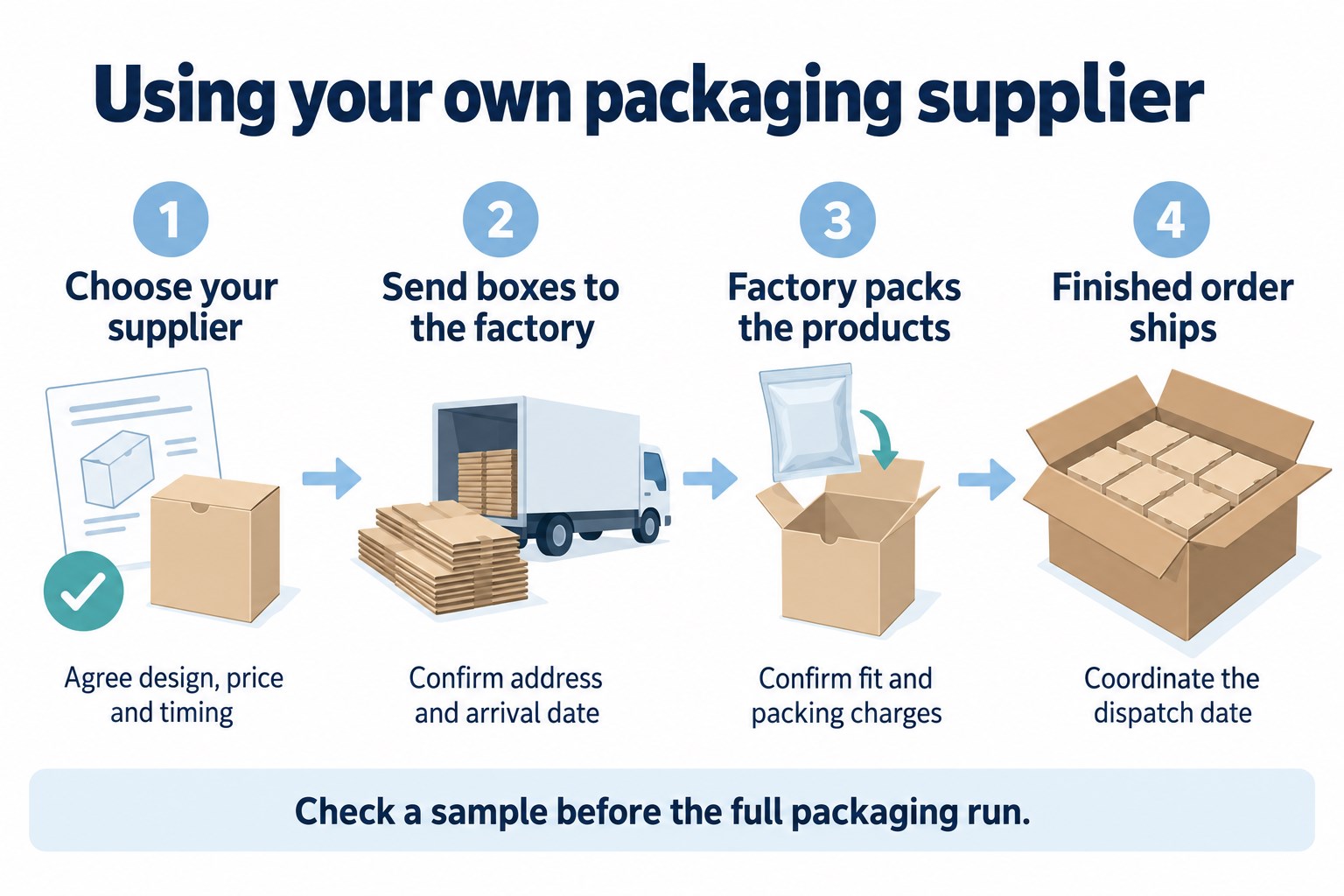
This allows brands to compare packaging quotations directly, follow production progress and work with an existing packaging partner if they have one.
Before the packaging is produced in full, confirm:
- The box and insert dimensions fit the product.
- The product factory can complete the required packing.
- The packaging quantity, delivery address and receiving contact are correct.
- The packaging will arrive in time for packing and dispatch.
- Any transport, storage or packing charges are understood.
Where possible, send a sample to the product factory for a fit check before the full packaging run.
Sourcing packaging directly can give the buyer more control over design and production arrangements, but it also requires coordination between two suppliers. Compare any apparent savings with transport, storage, packing, and scheduling costs before choosing this approach.
Confirm the packaging arrangement before payment
Whichever option is chosen, the quotation or order confirmation should clearly state:
- Product quantity: how many products are being purchased.
- Packaging option: custom boxes, standard packaging, sealed bags without outer boxes, or brand-supplied packaging.
- Packaging quantity: how many boxes or other packaging items will actually be produced and supplied.
- Cost: the total packaging charge and any separate transport, storage or packing fees.
- Timing: when packaging will be ready, when it will reach the factory and when the finished products can ship.
- Unused packaging: who will keep it and how it can be used later.
Small-order packaging can be confusing when a brand expects to pay only a large-order unit price multiplied by the few boxes needed. The packaging supplier may instead quote the same total for a range of quantities.
Knowing the total payment, how much packaging it provides and what happens to any boxes left over makes the quotation easier to understand. Comparing that arrangement with the other packaging choices helps brands select an option that fits their first order.
Packaging also affects the shipping plan. Once the retail boxes are agreed, compare the packed carton dimensions and minimum chargeable weight rules when checking transport quotations.
Retail presentation and transit protection serve different purposes. For example, FedEx’s General Packaging Guidelines recommend placing chipboard gift or shoe boxes inside a corrugated outer box. Confirm suitable protection for the product and the chosen shipping service.