
A carton weighs 4 kg, but the shipping quotation charges for 12 kg. Then the buyer discovers that ordering 1,200 pieces could cost the same to ship as ordering 1,000.
How can both be true?
The answer may be a minimum chargeable weight per carton. Some freight forwarders apply this rule to particular duty-paid shipping services. Understanding it can help buyers compare quotations, plan packing and decide whether a different order quantity makes sense.
This guide explains how duty-paid shipping works, why a partly filled carton can affect the bill, and what to ask a freight forwarding company before choosing a service.

What is duty-paid shipping?
In a duty-paid shipping arrangement, the agreed price includes the import duties specified in the quotation. The service provider arranges their payment as part of the shipment, rather than leaving those covered duties for the recipient to pay separately.
The useful distinction is who arranges and pays for the import charges. Duty-paid shipping does not mean the goods are exempt from duty. The cost is included in the agreed service price.
A freight forwarder may combine international transport, customs clearance and local delivery into one service. What is included needs to be confirmed in writing: duties, applicable import taxes, clearance fees and delivery charges are separate items, even when offered as one package.
Is this the same as DDP shipping?
DDP means Delivered Duty Paid. Under the ICC’s DDP Incoterms® 2020 rule, the seller handles import clearance and pays import duties and applicable taxes, delivering to the named destination with the goods ready for unloading. See the ICC’s explanation of DDP.
A forwarder’s label such as “duty-paid line” or “tax-included shipping” does not, by itself, establish all the responsibilities in a DDP sales contract. Confirm the agreed delivery terms, named destination and fee coverage.
Also, DDP describes responsibilities, not a transport speed. A duty-paid arrangement can use different transport modes; ask how the specific service moves the goods and how long delivery is expected to take.
Is duty-paid shipping available to every country?
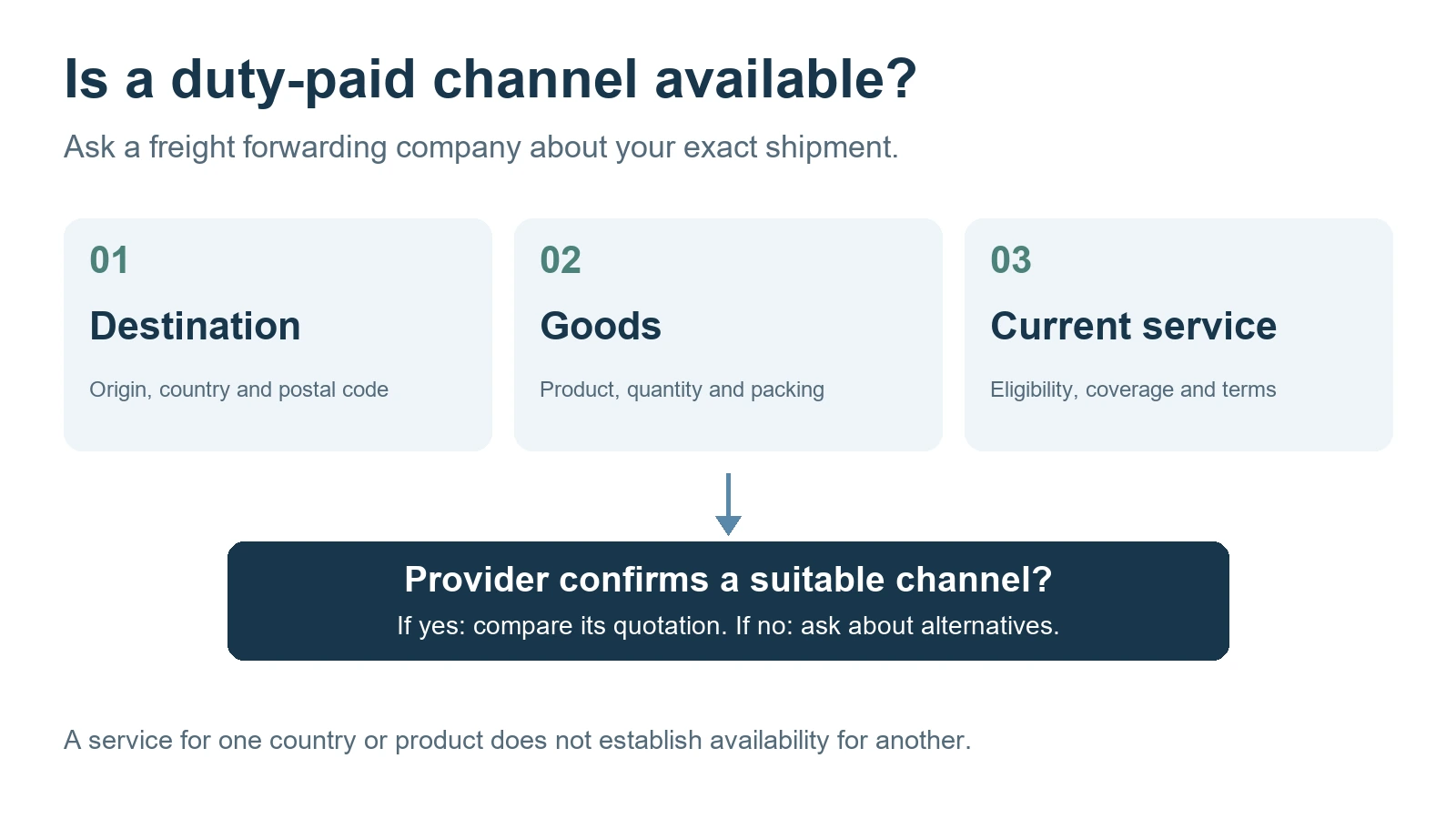
Availability depends on the freight forwarding company, the origin and destination, and the goods being shipped. One provider may offer a suitable duty-paid channel to a country while another does not. A service available for one product may not accept another.
Even when a channel exists, its weight limits, packing rules, delivery coverage and included charges can differ. A quotation for the United States should not be used to assume the same terms for Canada, the United Kingdom, an EU country or another destination.
Before discussing whether the service is economical, ask:
“Do you currently offer a duty-paid service for this product from the shipping origin to my country and postal code? What does the price include, and what are the packing and billing rules?”
A supplier can help obtain this information, or the buyer can ask a freight forwarding company directly. Both approaches work; the relevant details come from the provider of the actual shipping service.
Three weights that explain the shipping bill
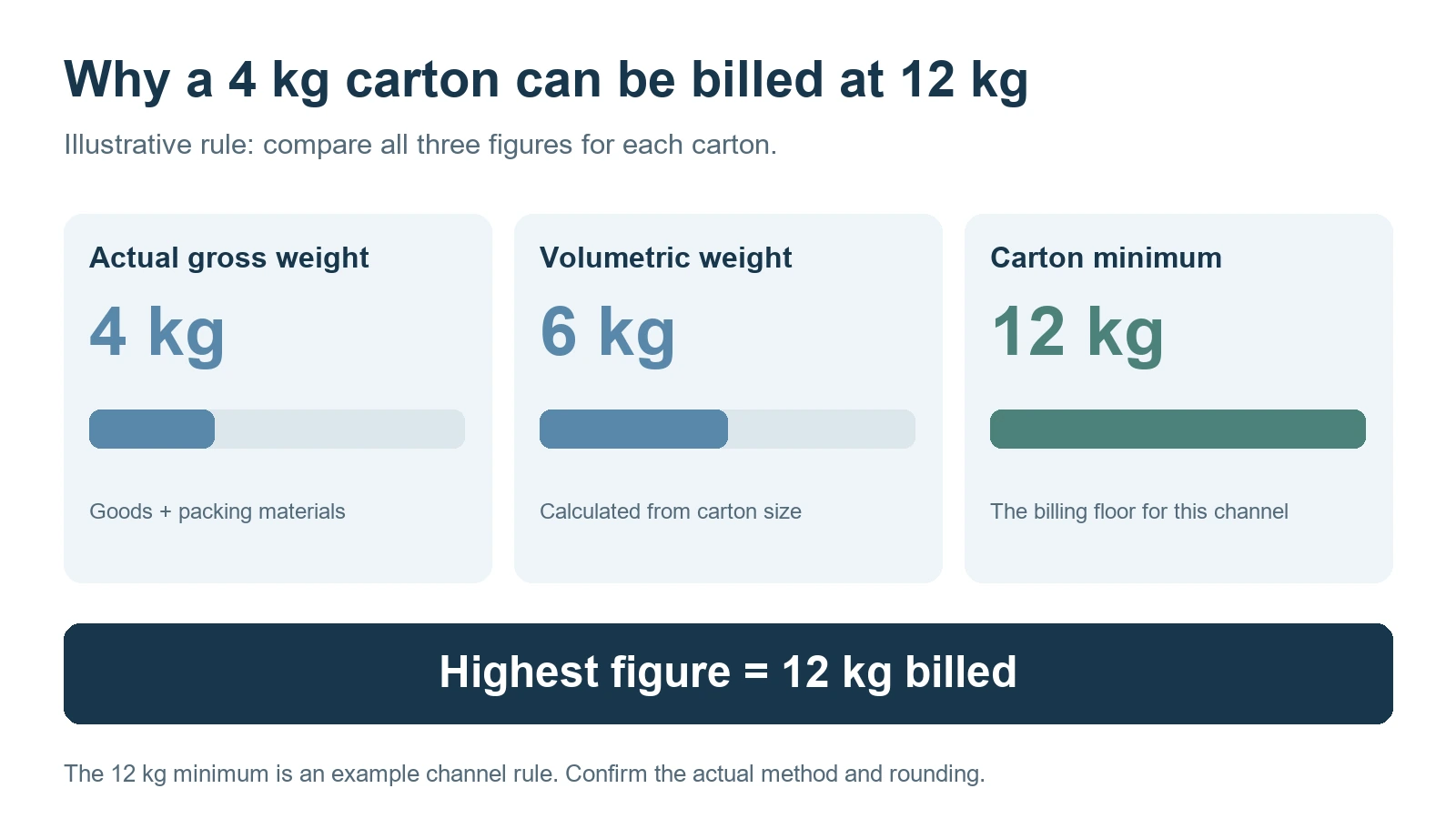
Shipping quotations can use a weight different from the figure on a scale. These three terms make the calculation easier to follow:
- Actual gross weight: the weight of the packed carton, including the goods, box and protective materials.
- Volumetric weight: a weight calculated from the carton dimensions. A large, light carton occupies space even when it weighs little.
- Minimum chargeable weight: a billing floor set by the service provider. A carton below that floor can still be billed at the minimum.
For a channel that compares all three on a per-carton basis, the calculation can be illustrated as:
Chargeable weight per carton = the highest of actual weight, volumetric weight and the carton minimum.
The provider may also round weights or apply separate fees. Confirm the actual calculation method, including whether the minimum applies to each carton or the whole shipment.
A quick example of volumetric weight
Using a divisor of 5,000, a carton measuring 40 × 30 × 50 cm has a volumetric weight of 12 kg: 40 × 30 × 50 ÷ 5,000 = 12.
If its actual weight is 4 kg, an express service using the higher of actual and volumetric weight can charge for 12 kg even without a 12 kg carton minimum. DHL explains this weight comparison. The divisor and rounding rules depend on the service.
Volumetric weight and a minimum chargeable weight are different rules. Ask which one caused the quoted weight to increase.
A United States example: 900, 1,000 or 1,200 pieces
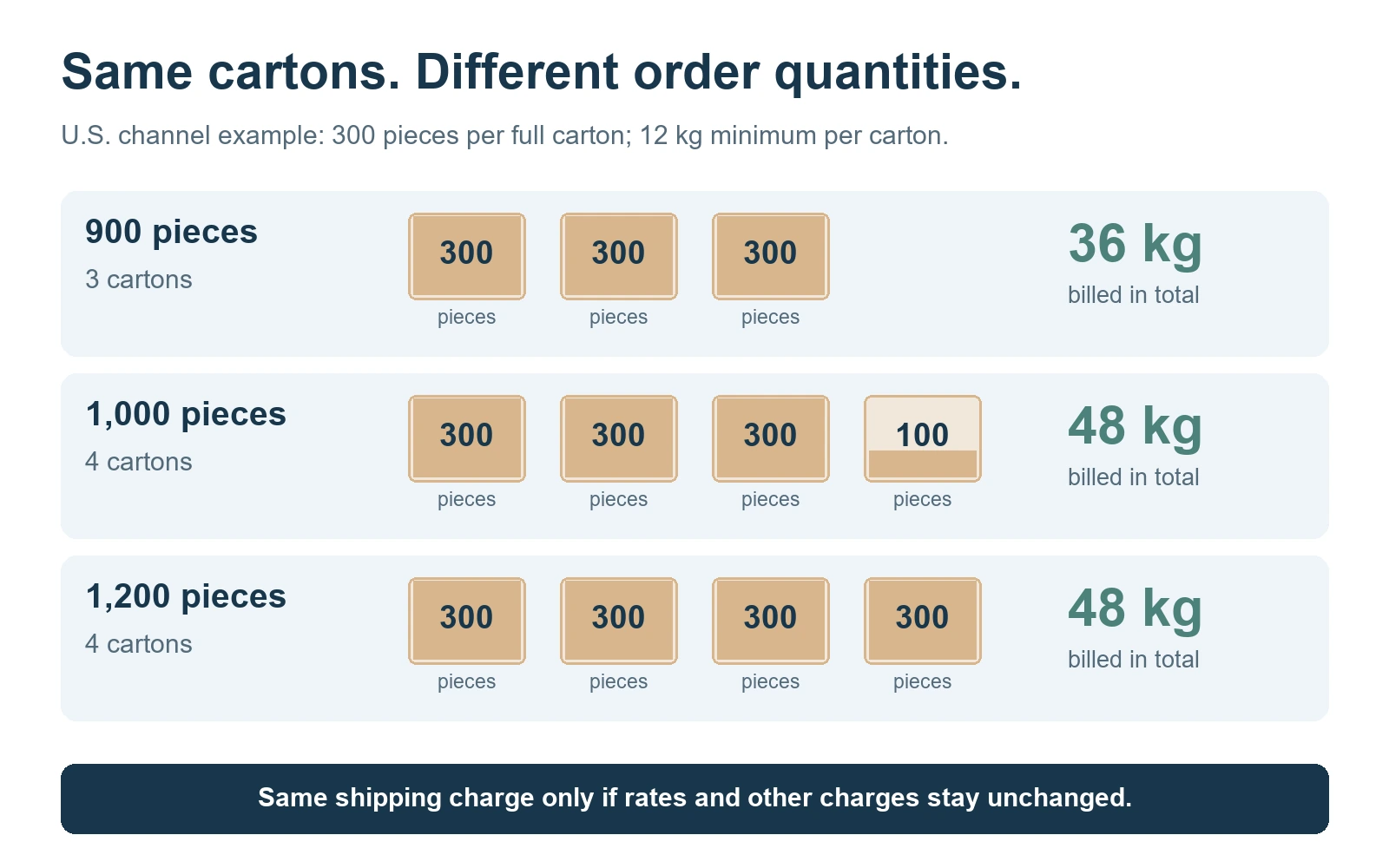
Consider an order using a particular freight forwarder’s duty-paid channel to the United States, with these packing and billing conditions:
- Each carton holds up to 300 pieces.
- A full packed carton weighs approximately 12 kg.
- The channel bills a minimum of 12 kg per carton.
- Volumetric weight does not exceed 12 kg for any of these cartons.
- The per-kilogram rate and other charges remain the same for all three options.
These conditions describe this example only. Neither the carton capacity nor the 12 kg minimum is a universal rule for duty-paid or DDP shipping.
| Order quantity | Packing | Cartons | Total billed weight |
|---|---|---|---|
| 900 pieces | 300 + 300 + 300 | 3 | 36 kg |
| 1,000 pieces | 300 + 300 + 300 + 100 | 4 | 48 kg |
| 1,200 pieces | 300 + 300 + 300 + 300 | 4 | 48 kg |
Why does the fourth carton matter?
The final 100 pieces require an additional carton. Even if that carton weighs only around 4 kg, the minimum means it is billed at 12 kg. Packing it into a smaller box will not remove that floor if the same per-carton minimum still applies.
At an illustrative rate of US$6 per billed kilogram, the weight-based shipping charge would be $216 for 900 pieces and $288 for either 1,000 or 1,200 pieces. This rate is invented for the calculation; it is not a current shipping quotation. No additional fees are assumed in this comparison.
Under those conditions, 900 pieces reduces that shipping charge by $72, or 25%, compared with 1,000. Moving from 1,000 to 1,200 uses the existing billed capacity without increasing that charge.
Does that mean 1,200 pieces is the best choice?
Not automatically. The additional 200 products still have to be purchased, stored and eventually used or sold. If the product price were $2 each, those extra products would add $400 before any other costs, even with no extra shipping charge.
A buyer who needs exactly 1,000 pieces may reasonably keep that quantity. A buyer with confirmed demand for 1,200 may prefer four full cartons. A buyer testing demand may prefer 900, provided that smaller quantity meets the purchasing need.
The useful comparison is the total spending for a quantity that fits the business. A lower shipping cost per piece is only one part of that decision.
How does this compare with shipping that excludes duties?
An express service that excludes duties may quote a lower transport price and may have no equivalent 12 kg carton minimum. But it can still use volumetric weight, billing increments, minimum charges or surcharges of its own.
Also, express delivery and duty coverage are separate choices. Express services can offer different duty-billing arrangements. The comparison should be between two specific quotations, rather than assuming every express shipment excludes duties.
| What to check | Duty-paid quotation | Quotation excluding duties |
|---|---|---|
| Import duties | Confirm which duties are included and who arranges payment. | Confirm who must arrange and pay applicable duties separately. |
| Billed weight | Ask about actual weight, volumetric weight and any carton minimum. | Ask about actual weight, volumetric weight, rounding and minimum charges. |
| Other charges | Check taxes, clearance, delivery and any excluded fees. | Add applicable taxes, clearance, brokerage and other fees to the comparison. |
| Delivery | Confirm transport mode, timing, tracking and destination coverage. | Confirm the same details for this service. |
For a United States import, product classification and origin can affect the duty rate. A broker or freight forwarder can help estimate charges from the product details, but CBP determines the correct duty rate. It is therefore more accurate to distinguish an estimate from a guaranteed total than to assume duties cannot be researched before arrival. See CBP’s guidance on determining duty rates.
Other import fees may also apply; CBP explains duties, taxes and other fees. For another country, check its customs authority and the destination-specific quotation. Tariff rules can change, so use information applicable to the actual shipment.
Compare the cost of receiving the goods
To compare services fairly, use the same product quantity, packing plan and delivery address. Add up:
Product cost + transport + import duties and taxes + clearance and delivery fees not already included.
Do not count duties twice when they are already included in a duty-paid quotation. Keep estimated charges separate from confirmed charges, and note any exclusions or possible adjustments.
A duty-paid quotation may suit a buyer who values an agreed budget and help arranging import charges. A duty-excluded service may suit a buyer with an established broker, a suitable courier account or a better total quotation. Availability, documentation, delivery timing and product eligibility can be just as relevant as price.
If carton utilization is poor, ask the freight forwarding company whether there is another suitable channel, a lower minimum or an acceptable alternative packing plan. Adding products is one option; changing the service can be another. Keep enough packaging to protect the goods.
What to ask a freight forwarding company
The following message can be copied and adapted for any provider:
“Please confirm whether you currently offer a duty-paid channel from [origin] to [destination country and postal code] for [product description].
The order is [quantity] pieces, packed in [number] cartons. Each carton is approximately [gross weight] kg and [length × width × height] cm.
Please confirm the included duties, taxes, clearance and delivery charges; any excluded fees; the actual and volumetric weight calculation; and any minimum chargeable weight per carton or per shipment.
Please also confirm who handles import clearance and acts as importer of record, what documents are provided or needed, the estimated delivery time, quotation validity and circumstances that could change the price.
If available, please quote a suitable alternative service so the total costs can be compared.”
If nearby order quantities are practical, ask for separate packing plans and quotations for each. This makes any carton minimum visible before the order is finalized.
Frequently asked questions
Does every duty-paid shipping channel have a 12 kg minimum?
No. The 12 kg minimum in this article belongs to the example channel. Other providers and destinations may use different minimums or no equivalent per-carton minimum. Ask the freight forwarding company for the current rules.
Can a 4 kg carton be charged as 12 kg?
Yes, if the agreed channel has a 12 kg carton minimum, or if the carton dimensions produce 12 kg of volumetric weight under that service’s formula. Those are different reasons for the same billed weight.
Will 1,000 and 1,200 pieces always cost the same to ship?
No. They do in the example because both use four cartons billed at 12 kg each, with unchanged rates and other charges. Different product weights, packaging, duties or pricing rules can change the result. Obtain separate quotations.
Does duty-paid shipping guarantee no extra bill on arrival?
The covered import duties should already be included in the agreed price. Confirm the full scope and exclusions, including taxes, clearance, delivery and any exceptional charges. The service label alone is not enough to establish an all-inclusive total.
Is duty-paid shipping available for my country?
It depends on the freight forwarding company’s current services, the route and the product. Ask for confirmation for your exact destination and goods before using another shipment’s terms to estimate your own costs.
A practical next step
Before choosing a shipping method or changing an order quantity, ask a freight forwarding company for a destination-specific quotation and carton breakdown. Knowing what is included, how each carton is billed and which alternatives are available makes the decision easier to understand.
A partly filled carton is sometimes worth paying for. At other times, a different quantity or service makes better use of the budget. The appropriate choice is the one that meets the purchasing need at an acceptable total cost.
Illustrative packing figures and prices are used for explanation, not as a quotation. Service availability, billing rules and import charges must be confirmed for the destination and shipment. References checked on October 11, 2026.