
What are microneedling needles made of?
Start with the needle body: stainless steel, commercially pure titanium or a titanium alloy, with its grade specified. Then identify any surface treatment, such as gold plating or titanium nitride (TiN). Surface color alone does not identify the body material.
The distinctions below help interpret labels for rollers, stamps and needle cartridges. They explain material descriptions; records for a specific model must confirm which construction it uses.
Why do different needles look gold?
Gold plating and TiN coatings can produce similar golden appearances while leaving a steel needle body underneath. A golden appearance alone does not identify either the surface treatment or the body material.
The examples in this table separate the needle body from its surface. They explain descriptions rather than confirming which constructions are used in any particular roller, stamp or cartridge.
| Description | Needle body | Surface / appearance |
|---|---|---|
| Uncoated stainless steel | Specified steel grade | Finished steel surface; metallic grey |
| Gold-plated stainless steel | Specified steel grade | A thin gold-containing metal layer |
| TiN-coated stainless steel | Specified steel grade | A golden titanium-nitride ceramic layer |
| Titanium or titanium-alloy needle body | Specified commercially pure titanium grade or titanium alloy | Normally silver-gray; any surface treatment should be described separately |
Gold plating adds metal. TiN adds a ceramic coating. Color anodizing changes titanium’s oxide surface. A photograph alone cannot distinguish these constructions.
Stainless steel, coatings and titanium explained
Stainless steel: the needle body
Stainless steel is a family of materials, so its grade is part of a precise description. The wire-price example in this article uses 304 stainless steel; other grades also exist.
The material name is separate from the needle arrangement. Individually mounted needles, toothed roller discs and cartridge needle assemblies have different structures. Needle counts and roller or stamp configurations describe another part of the device, rather than identifying its metal.
Gold plating: a metal layer over steel
A gold-plated stainless steel needle has a steel body with a thin gold layer on its surface.
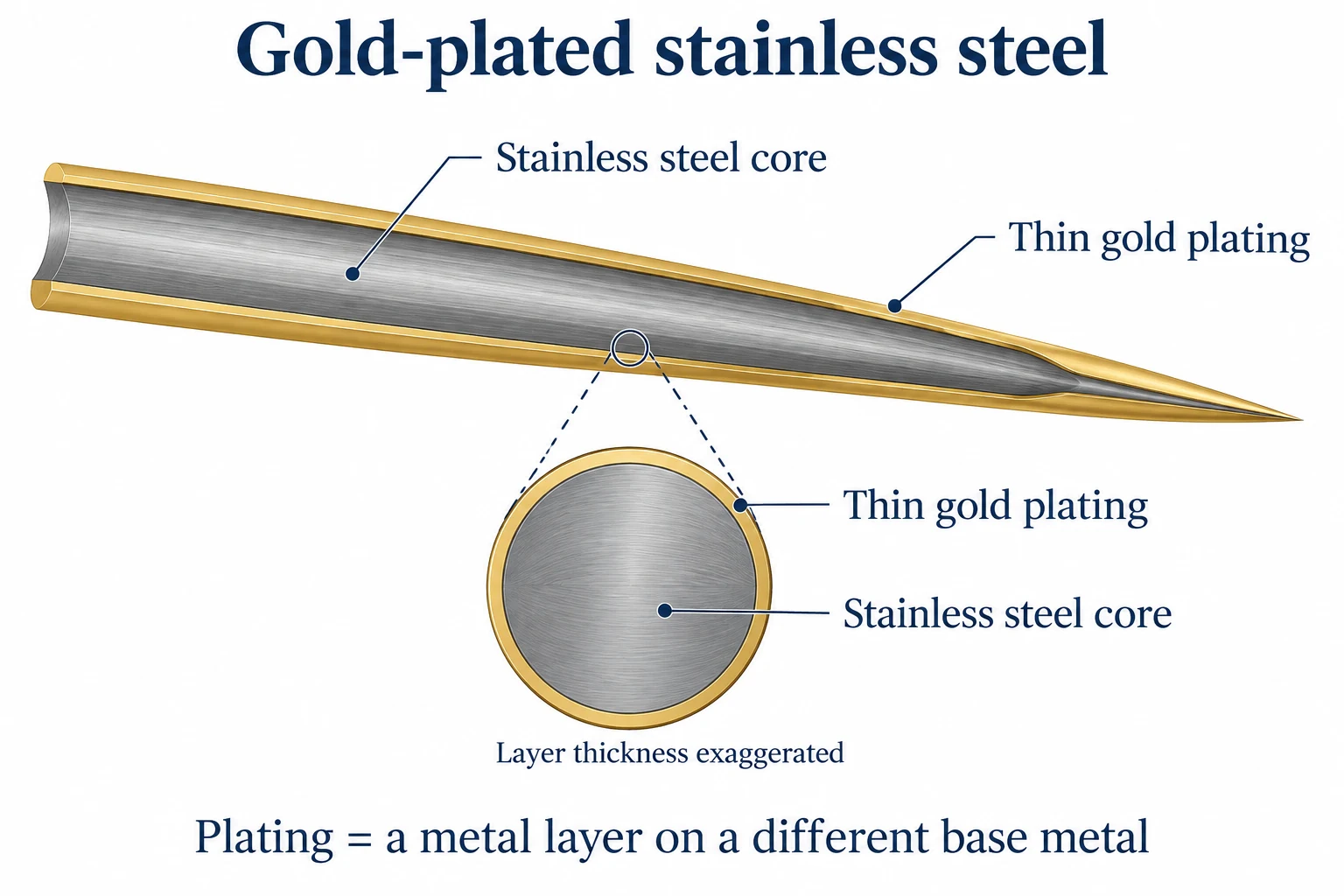
“24K gold-plated” describes the gold layer’s purity when that claim is substantiated. It does not specify the layer’s thickness. Gold purity, coating thickness and any intermediate layers are separate details. A 24K label alone does not establish coating durability.
Plating adds a processing step. Preparation, layer thickness, quantity and inspection all contribute to its cost.
TiN coating: titanium in the surface layer
TiN means titanium nitride, a ceramic compound containing titanium and nitrogen. TiN-coated stainless steel still has a steel body.
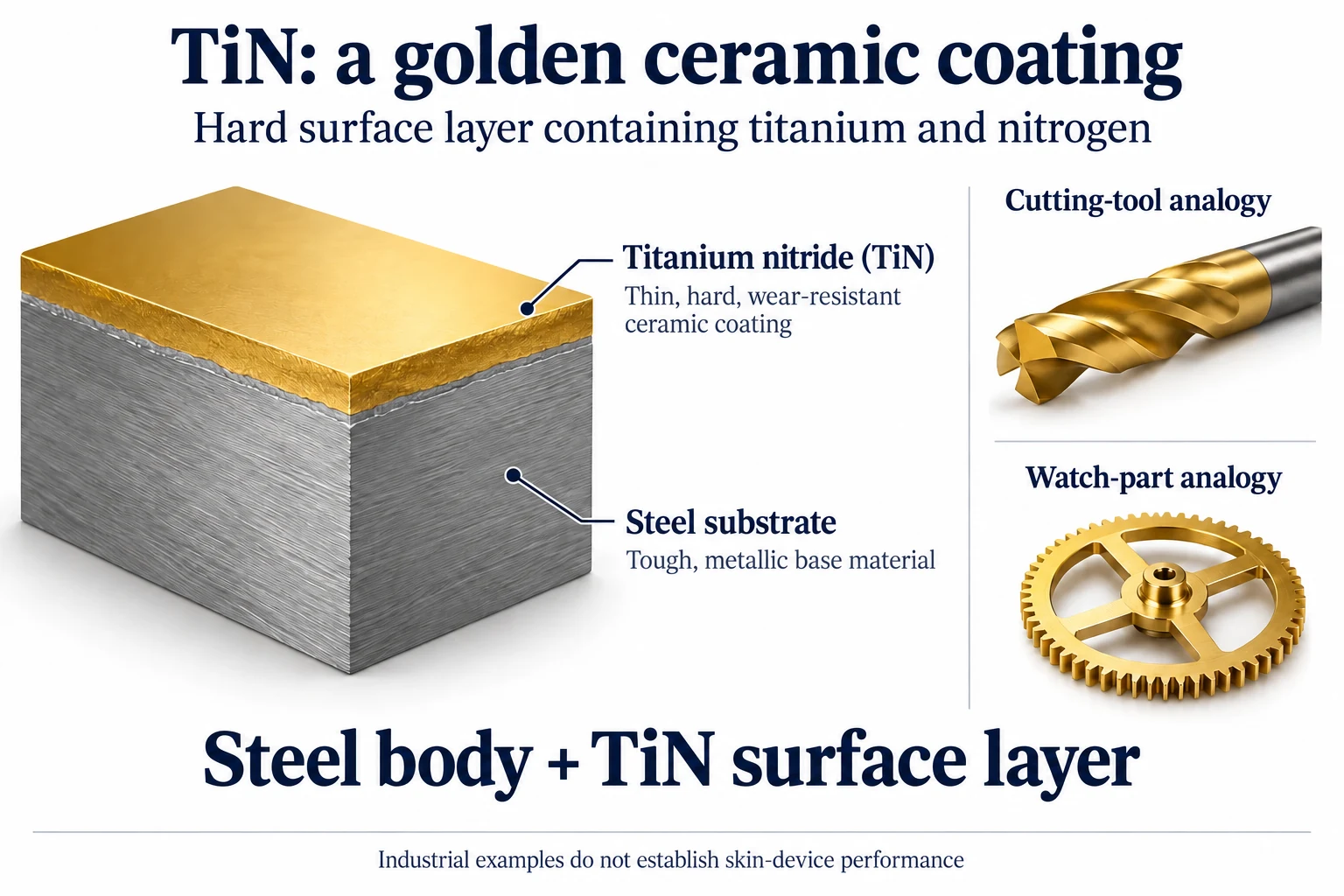
A golden drill bit is a familiar example of this layered construction. Oerlikon Balzers describes TiN as a gold-colored coating used on tools and instruments. Its presence at the surface does not make the underlying metal a titanium alloy.
Titanium: the body itself is titanium
“Solid titanium” is used here to mean that the needle body is titanium material throughout, rather than steel with a titanium-containing coating. The material may be commercially pure titanium or a titanium alloy; its grade should be stated separately.
Titanium is normally silver-gray, as described by the U.S. Geological Survey. A gold-colored titanium body therefore needs a separate explanation of its surface finish. Titanium alloy and titanium nitride are different materials.
A note on anodized titanium
Is titanium always better than stainless steel?
The material name alone does not establish which finished needle performs better. The grade, needle geometry, tip condition, surface finish and coating integrity all matter. Claims about sharpness, service life or treatment results need evidence for the finished device; neither a titanium label nor a gold color provides that evidence.
Why needle prices differ
A needle’s material is only one part of its cost:
The raw-wire example below concerns only one part of these costs. It cannot determine the selling price of a roller, stamp or cartridge.
Raw wire: two matched catalog items
Advent listed 100 m of each 0.25 mm annealed wire at £137 for 304 stainless steel and £301 for Grade 1 commercially pure titanium, about 2.2 times the steel quotation. Grade 1 is commercially pure titanium rather than a titanium alloy; 100 m is the purchase length, not a needle length.
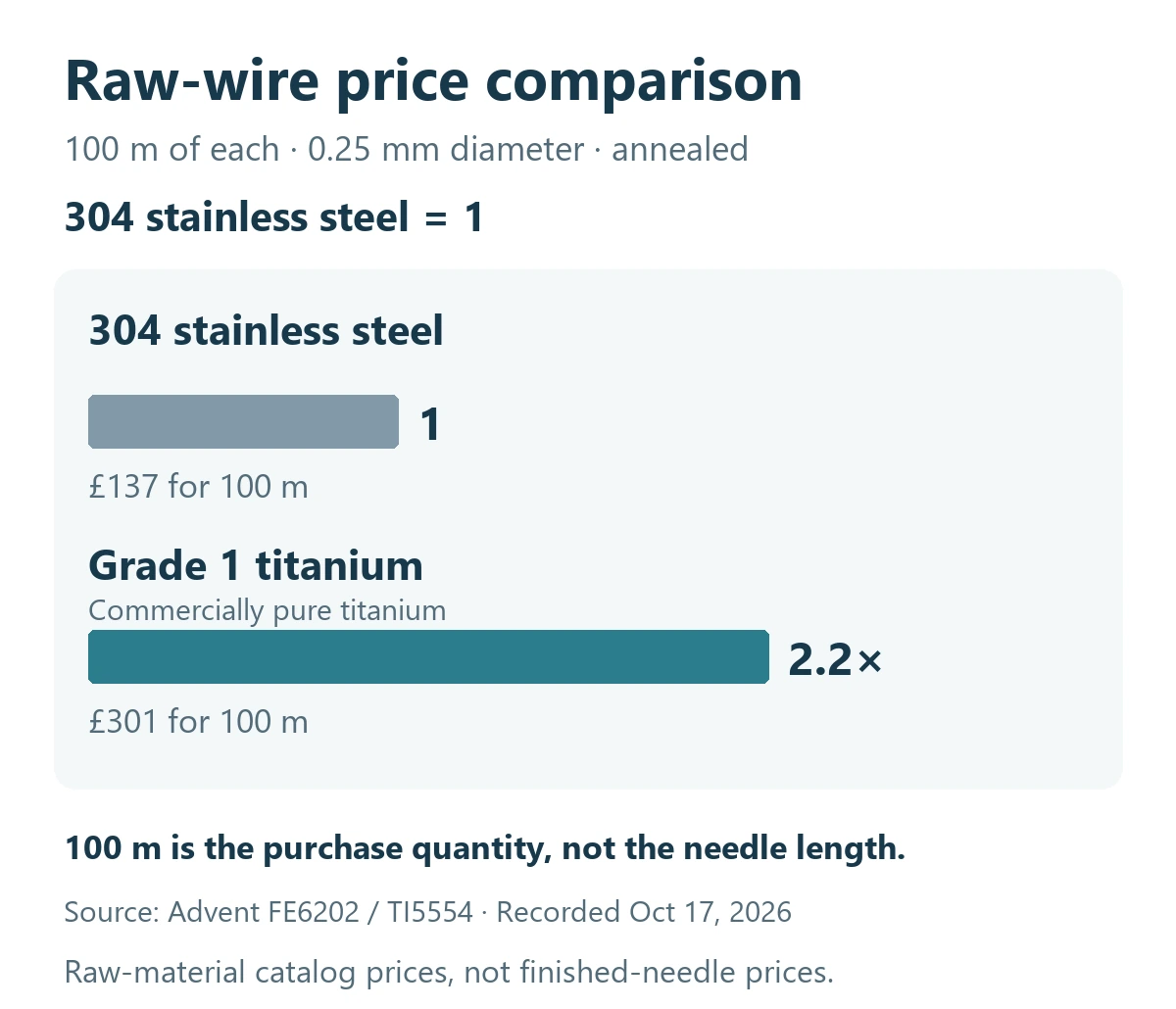
Sources: Advent 304 wire, FE6202 and Grade 1 titanium wire, TI5554. Prices were checked in the same pounds-sterling regional setting on October 17, 2026. These research-material catalog quotations apply only to these two items, not finished needles or a general steel-to-titanium price ratio. Grade 1 is included solely for this raw-wire comparison; the material used in a specific microneedling model requires separate confirmation.
How to read a needle material label
Separate the needle body from its surface
A clear label answers two questions: what is the needle body made of, and what is on its surface? It should also make clear which component the description covers: individual needles, a toothed roller disc, or another device part.
- “Gold-plated 304 stainless steel”: a 304 steel body with gold plating.
- “TiN-coated stainless steel”: a steel body with a titanium-nitride coating.
- “Titanium needle body, grade specified”: a commercially pure titanium or titanium-alloy body with its grade stated; any surface finish is described separately.
Whatever the price, confirm whether “titanium” describes the needle body or a surface treatment. Selling price alone cannot establish the material.
Three questions to support a material description
- What is the needle body’s material grade? Ask for the steel grade, commercially pure titanium grade or titanium alloy designation, and the material record for the needle component.
- What is the surface treatment and layer specification? Ask for the stated process, layer material and thickness where applicable, and any intermediate layers.
- Which model and batch do the records cover? Ask for records identifying the specific model, batch and component supplied. Records for another product do not confirm the construction of the supplied model.
Start with supplier material and coating records tied to the stated model and batch. If those records leave the composition uncertain, suitable laboratory analysis can provide additional evidence. Tip-consistency and surface-integrity inspections assess geometry and condition; they do not by themselves establish chemical composition.
Three distinctions to remember
- Color describes appearance. Different surface processes can produce a similar gold color.
- The body and surface are separate. TiN-coated steel has a steel body; a titanium needle body is a different specification.
- Prices need context. Raw material, processing and finished-device selling prices describe different things.