
Needle body, surface and color
A gold-colored needle is not necessarily made of gold. A coating that contains titanium does not make the needle underneath solid titanium. These distinctions apply to material descriptions across microneedling rollers, stamps and needle cartridges.
Three separate details make a description clear: the metal inside the needle, the treatment on its surface, and its apparent color. The constructions below explain these differences; they do not imply that every option is used in every device design.
Three ways a needle can look gold
A golden finish can come from gold plating on steel, a TiN coating on steel, or anodizing on titanium. The color may look similar even though the needle body and surface are different. Figure 1 shows all five constructions discussed in this article.
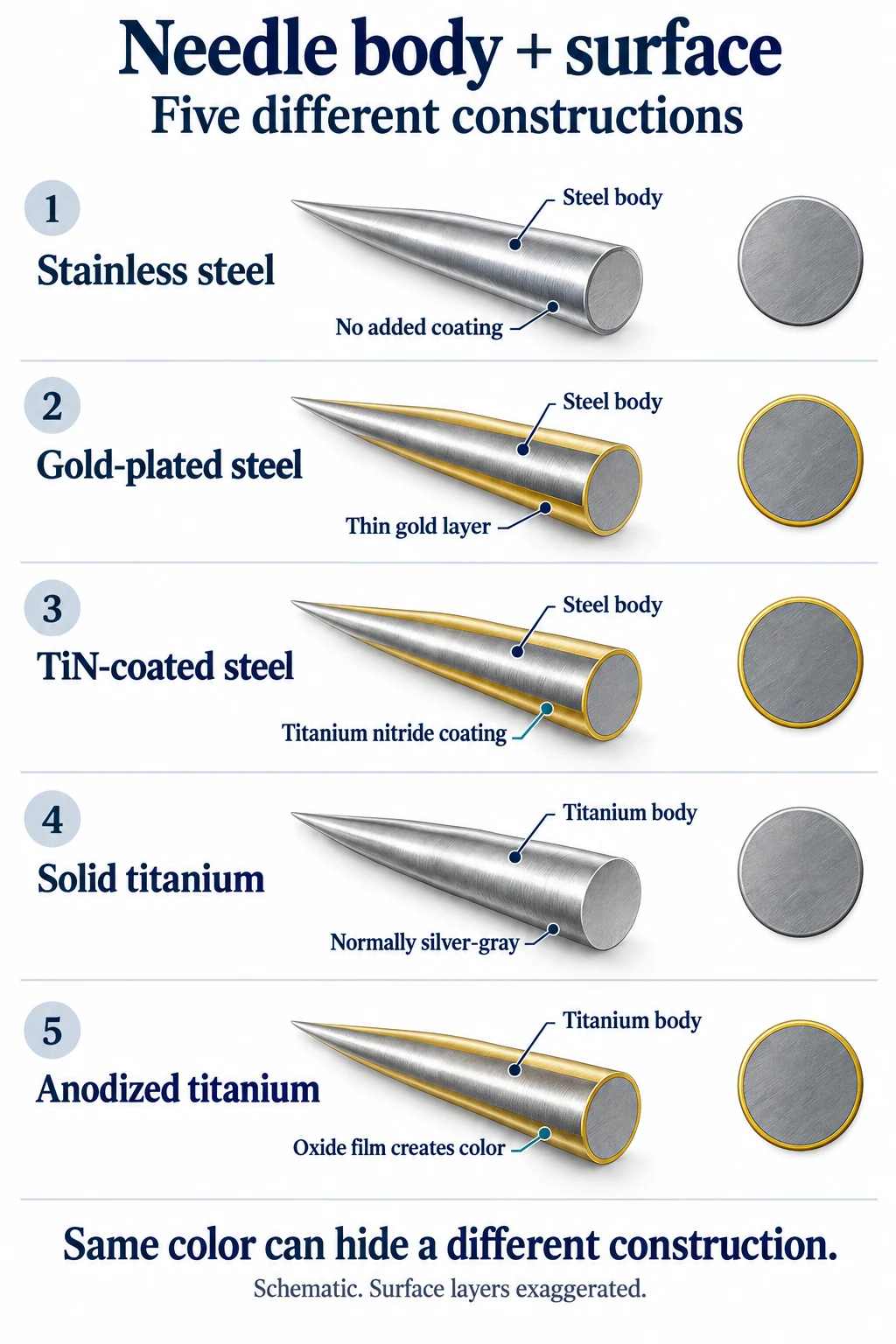
The grey center in the coated-steel examples is the steel needle body. The gold-colored edge represents the added surface layer. In anodized titanium, the color comes from an oxide film on the titanium itself.
| Description | Needle body | Surface / appearance | Cost components |
|---|---|---|---|
| Uncoated stainless steel | Specified steel grade | Finished steel surface; metallic grey | Steel + needle manufacturing |
| Gold-plated stainless steel | Specified steel grade | A thin gold-containing metal layer | Steel needle + gold plating |
| TiN-coated stainless steel | Specified steel grade | A golden titanium-nitride ceramic layer | Steel needle + TiN coating |
| Solid titanium | Specified titanium grade or alloy | Normally silver-gray | Titanium + needle manufacturing |
| Gold-colored anodized titanium | Specified titanium grade or alloy | An oxide film creates an optical gold color | Titanium needle + anodizing |
Gold plating adds metal. TiN adds a ceramic coating. Color anodizing changes titanium’s oxide surface. Appearance alone cannot identify which construction is present.
Needle materials and surface treatments
Stainless steel: the reference material
“Stainless steel” names a family of materials. A complete description also gives the grade and manufacturing details. The price example later in this article uses 304 stainless steel; that does not mean every stainless steel needle is 304.
Material and construction are separate. Individually mounted roller needles and toothed roller discs have different structures. Stamps and cartridges also have their own needle arrangements. The same material name does not make these designs equivalent.
The finished needle still needs defined dimensions, tip consistency and surface condition. Those details cannot be inferred from the steel grade alone.
Gold plating: a metal layer over steel
Gold-plated stainless steel has a steel body with a thin gold-containing outer layer. Figure 2 shows why a golden needle can still be steel inside.
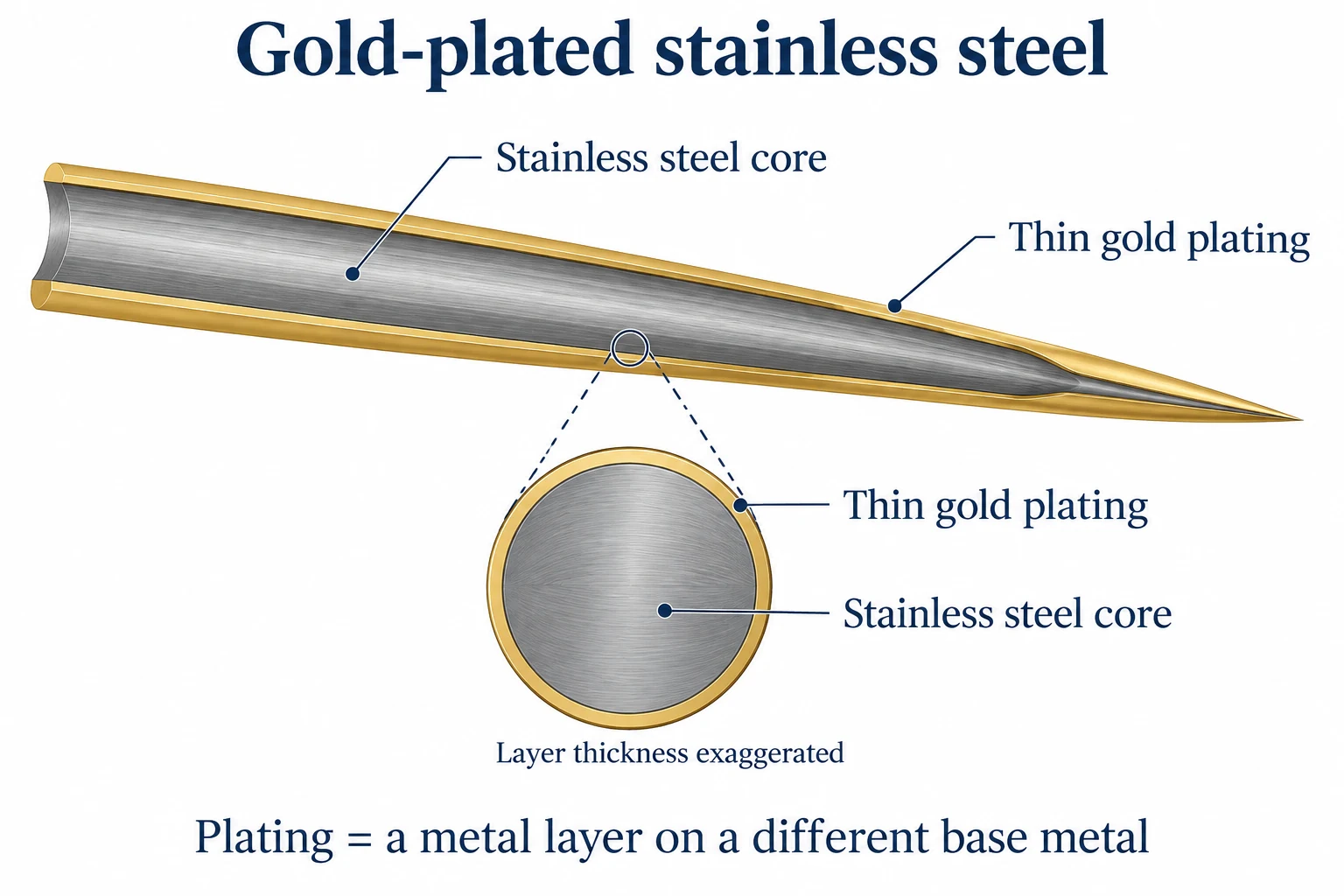
“24K gold-plated,” when substantiated, describes the gold layer’s composition or purity. It does not mean the entire needle is gold, or state how thick the layer is. A useful specification identifies layer composition, thickness, any intermediate layers and how coverage is checked.
Plating adds processing to the steel needle. Its cost depends on the finish specification, preparation, quantity and inspection, rather than on the word “gold” alone.
TiN coating: titanium in the surface layer
TiN is titanium nitride, a ceramic compound containing titanium and nitrogen. On TiN-coated stainless steel, the needle body remains steel. Titanium in the coating does not turn that body into a titanium alloy.
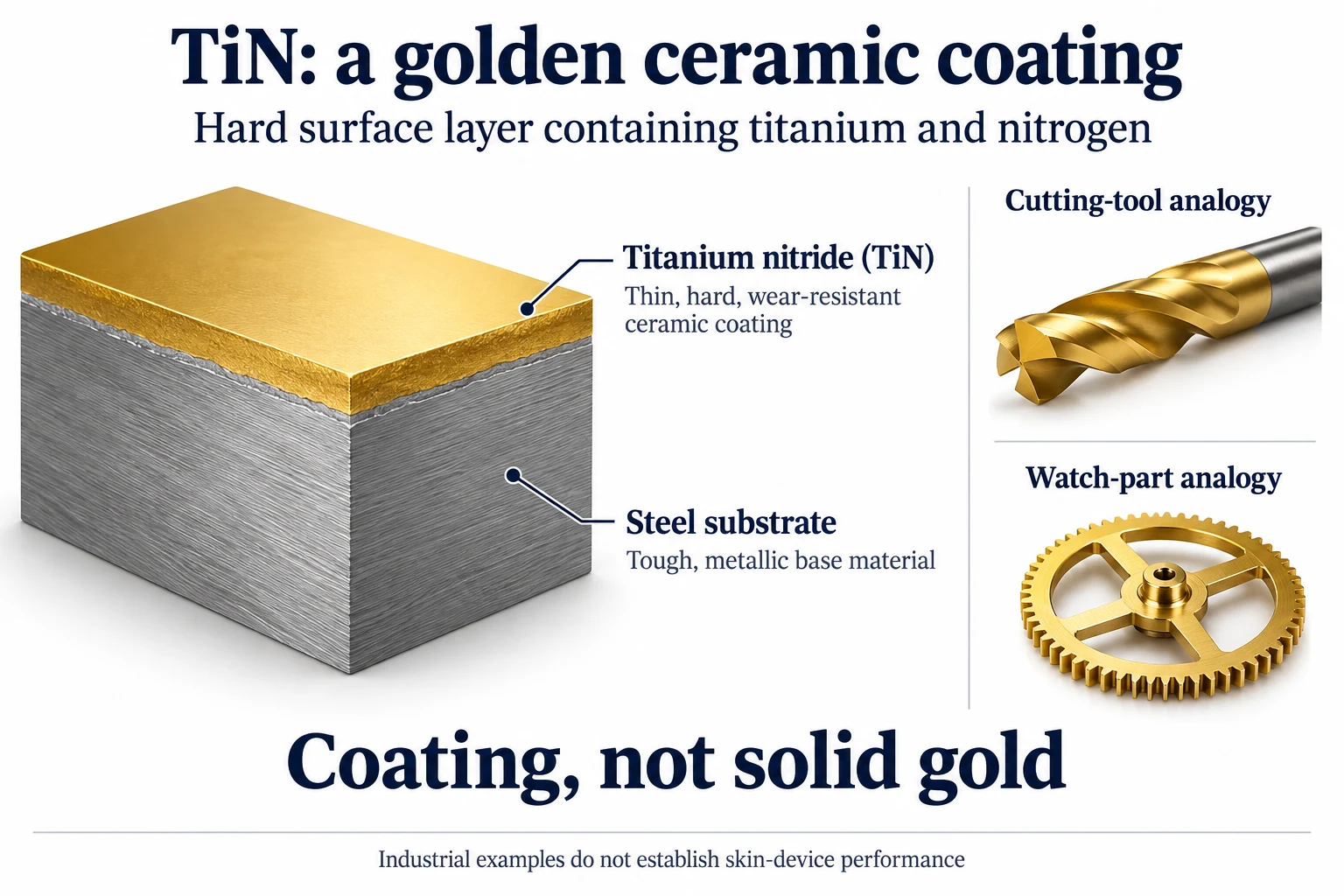
A golden drill bit provides a familiar analogy: a colored surface does not identify the metal underneath. Industrial suppliers describe TiN coatings for tools, components and instruments; Oerlikon Balzers explains TiN-based coatings.
For a finished needle, coating thickness, coverage, adhesion and tip condition matter. An industrial tool example explains the layered construction; it does not establish comfort or skin-treatment performance.
Solid titanium: the body itself is titanium
“Solid titanium” means the needle body itself is titanium material, rather than steel with a titanium-containing coating. It may be commercially pure titanium or a titanium alloy; the exact grade belongs in the specification.
Uncolored titanium is normally silver-gray, as described by the Royal Society of Chemistry. In Figure 1, the solid-titanium example has a titanium center, while both coated-steel examples have steel centers.
Titanium alloy and titanium nitride are different materials. A titanium name also does not, by itself, establish a sharper tip, longer service life or a better treatment result.
Anodized titanium: gold color without gold metal
Color anodizing grows a controlled oxide film on titanium. The film changes how reflected light combines, producing visible color without depositing gold. Xometry explains titanium anodizing.
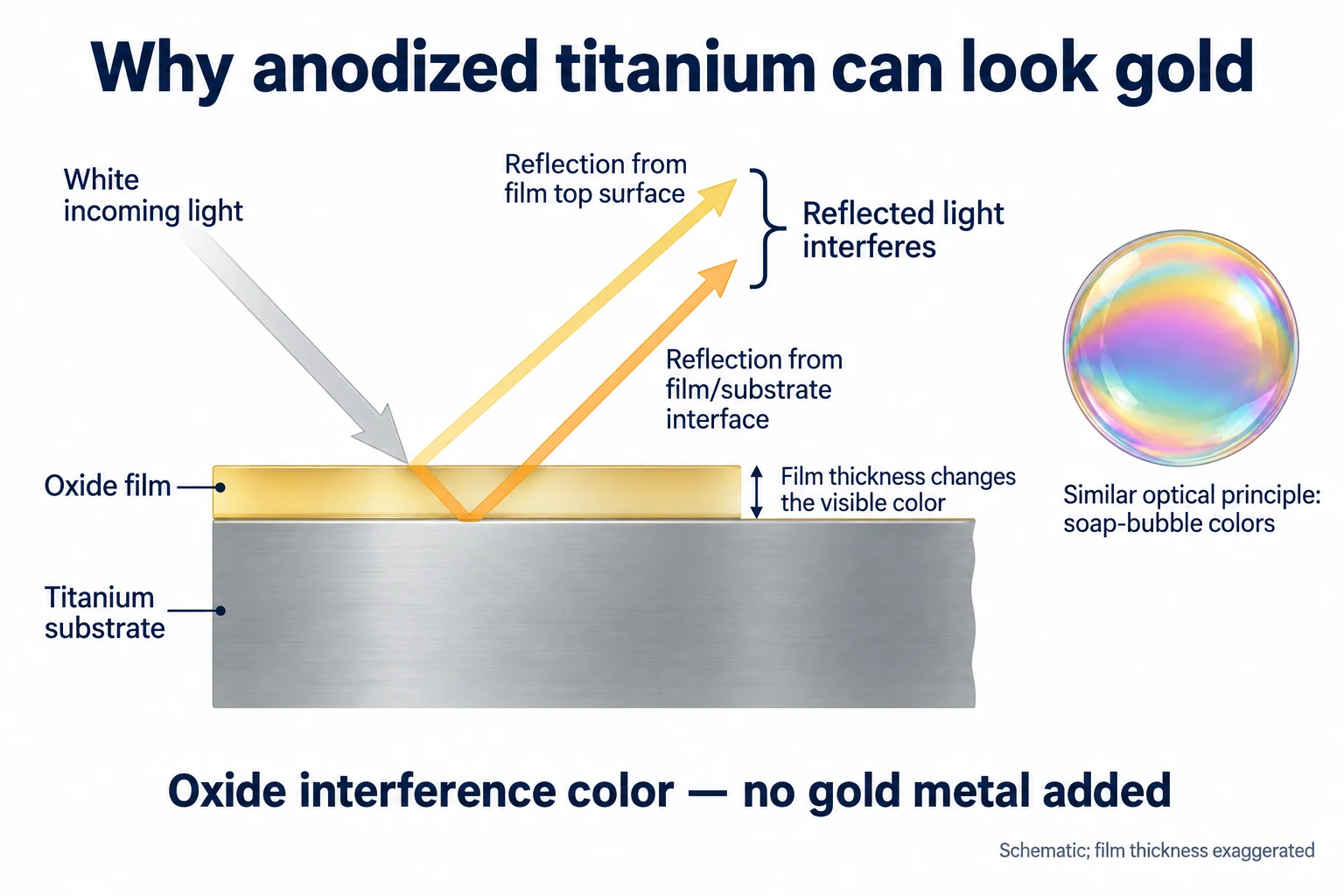
The colors on a soap bubble provide a useful optical analogy. Light reflects from different boundaries of a thin film; the reflected waves reinforce or cancel different wavelengths. Changing the film thickness changes the visible color. The analogy explains the light effect, not the ingredients of the finish.
Color anodizing is distinct from titanium treatments designed for wear resistance or anti-galling. Tiodize describes these different processes. A golden surface therefore does not automatically carry every benefit associated with titanium surface treatments.
A description of gold-anodized titanium needs evidence of both the titanium body and its surface process. A photograph cannot confirm either, and the color alone does not establish a clinical advantage.
Understanding the cost differences
Cost becomes easier to follow when it is separated into stages:
A wire price covers the starting material. A plating or coating minimum covers a service order. Neither is the complete cost of a needle, roller, stamp or cartridge. The following public examples show the distinction.
Raw wire: 304 steel and Grade 1 titanium
Advent lists both examples below as 0.25 mm, annealed wire. The amounts shown were checked in the same pounds-sterling regional setting on October 17, 2026.
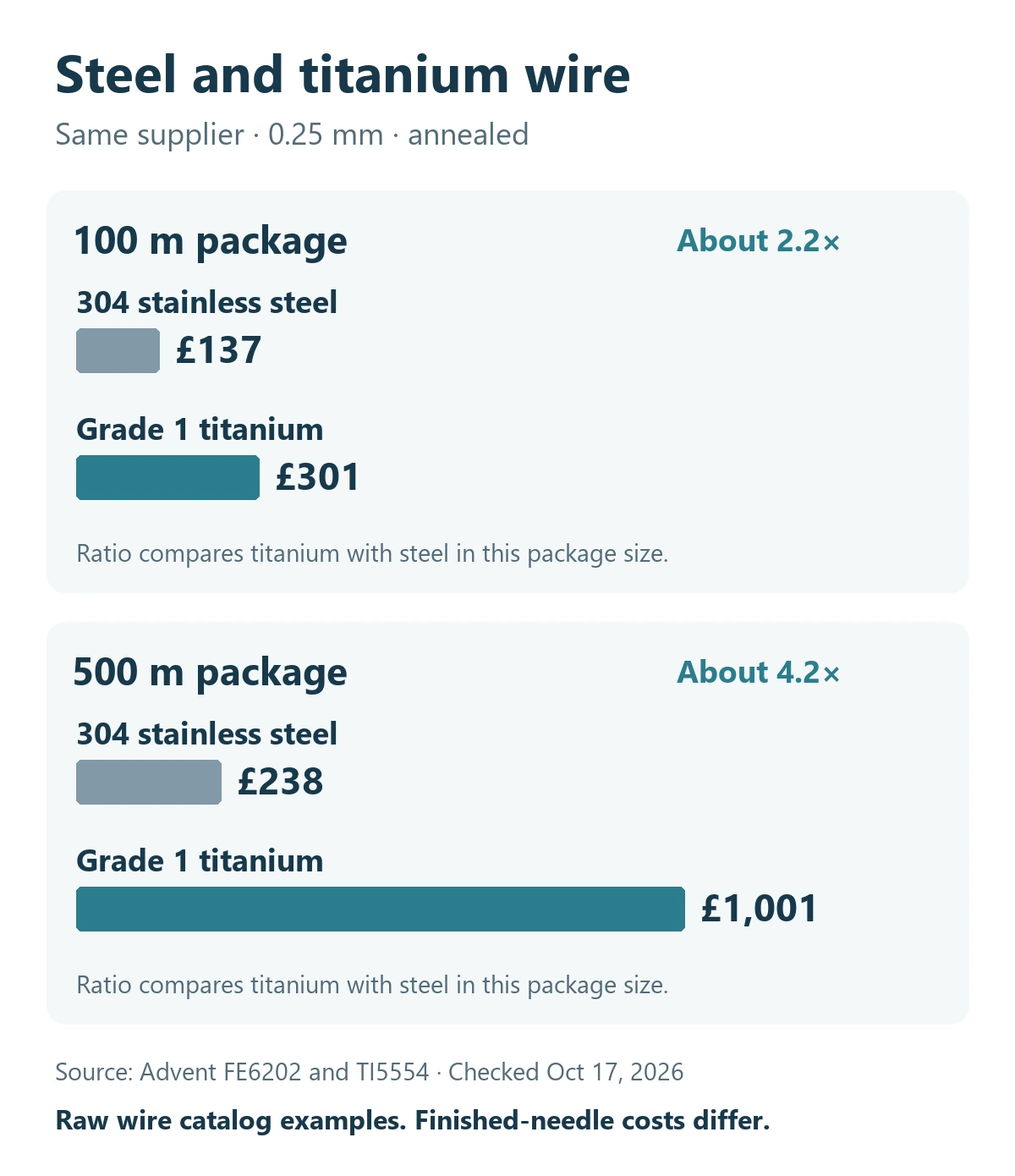
| Length | 304 steel, FE6202 | Grade 1 titanium, TI5554 | Titanium / steel price |
|---|---|---|---|
| 100 m | £137 | £301 | About 2.2× |
| 500 m | £238 | £1,001 | About 4.2× |
Sources: Advent 304 wire and Advent Grade 1 titanium wire. These are research-material catalog examples. The ratios describe these two packages, not a general market range or finished-needle cost. Suitability still depends on the actual needle specification.
Surface processing: three separate services
All three finishes below add a process to an existing part. Their published minimums are useful examples of how finishing is charged, rather than quotations for the microneedles in this article.
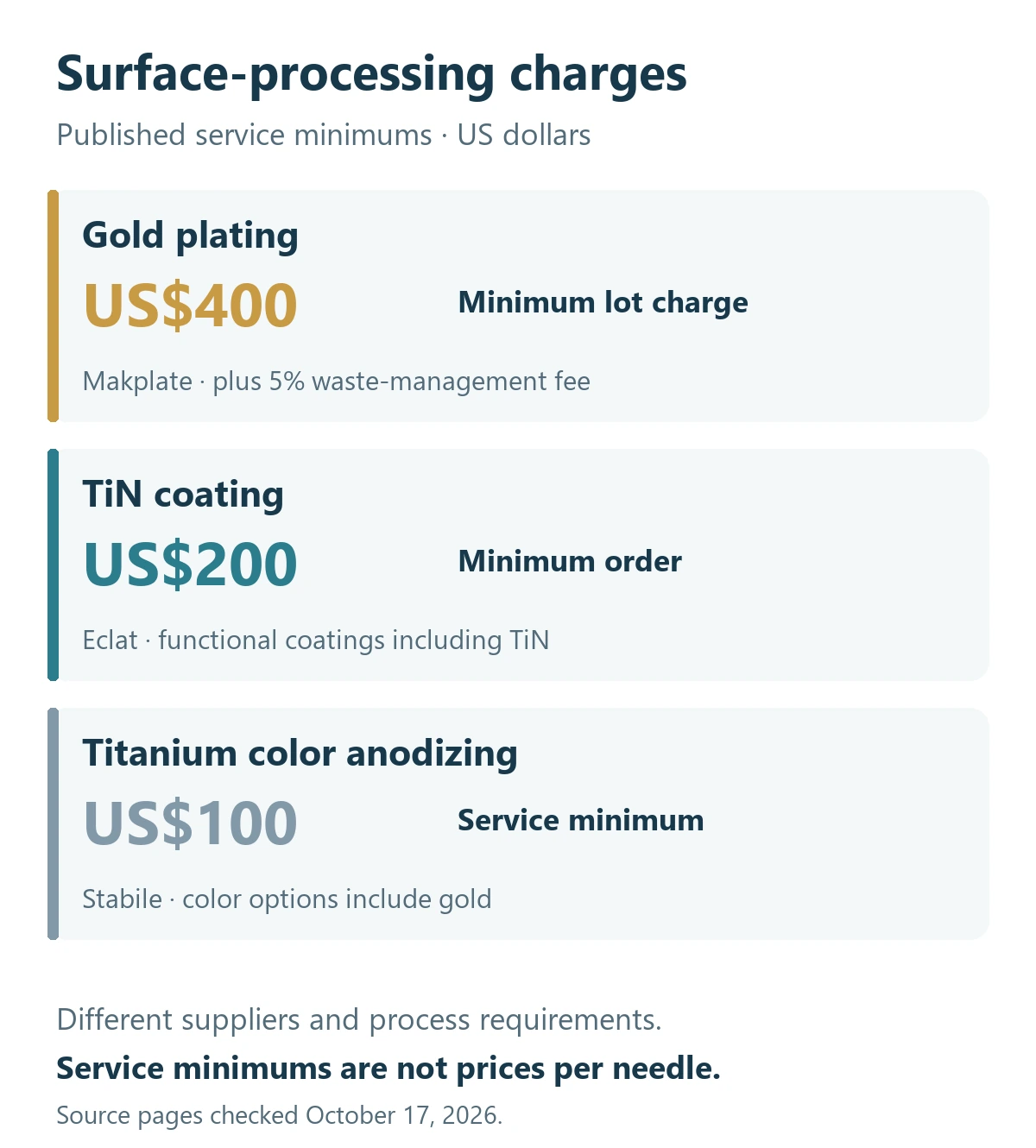
| Finish | Published minimum | What the amount means |
|---|---|---|
| Gold plating | US$400 per minimum lot | Makplate’s general gold-plating minimum. A 5% waste-management fee applies; multiple layers are charged separately. |
| TiN coating | US$200 minimum order | Eclat’s functional-coating minimum includes TiN. The metal part and its manufacture are separate. |
| Titanium color anodizing | US$100 service minimum | Stabile lists titanium coloring, including gold shades. The titanium part is separate. |
Service pages checked October 17, 2026. Different providers, quantities and process requirements are involved, so the figures do not rank the finishes by finished-needle cost or confirm that a particular needle design can be processed at those amounts.
Batch size matters: a charge is spread across the number of acceptable parts it covers. Preparation, fixtures, coating thickness, inspection and rejected parts can change that calculation. A complete comparison therefore needs the same needle design, quantity and quality requirements.
How to read a material specification
When a titanium label and the price seem out of step: if an otherwise comparable version described as solid titanium is priced almost the same as stainless steel, it is worth checking whether “titanium” describes the needle body or only a surface coating. Similar selling prices can also have other commercial explanations, so price alone cannot establish the material inside.
A precise description, such as “TiN-coated 304 stainless steel” or “Grade 1 titanium needle body,” together with batch-linked material records, is more informative than an unqualified “titanium needle” label.
Identify the needle body and each surface layer
A clear specification answers five questions:
- Body: which steel grade, commercially pure titanium grade or titanium alloy?
- Surface: gold plating, TiN, anodizing or another process?
- Layers: what is present, including any intermediate layer?
- Thickness: what thickness, tolerance and measurement method apply when a layer thickness is claimed?
- Component: does the description refer to the needle itself, a disc, an assembly or another device part?
“Gold-plated stainless steel needles” and “TiN-coated stainless steel needles” identify different constructions. “Gold titanium needles” leaves the body and surface unclear.
Match the description to the actual batch
Material certificates, coating records, inspection results or suitable laboratory analysis can connect the description to a production batch. Surface composition and the metal underneath are different questions, so one test may not establish both.
A diagram explains a construction. A microscope image can show visible geometry. Neither alone proves chemical composition. Relevant finished-part evidence also covers dimensions, tip consistency, surface condition and coating integrity.
The three distinctions to remember
- Color is appearance. Similar gold finishes can come from different processes.
- The body and surface are separate. TiN-coated steel remains steel inside; anodized titanium has a titanium body.
- Material price is one cost component. Manufacturing, surface treatment and assembly also contribute, while treatment performance requires its own evidence.